
 MXN
 Spain & Europe · EUR
 United States · USD
The Bermuda Triangle of Calcium: Why Vitamin D3 needs K2 (and Magnesium) to avoid shipwreck

In the world of modern nutrition, we've moved on from simply "avoiding illness" to seeking the total optimisation of our biology. In this race for longevity, one dynamic duo has stolen the spotlight: Vitamin D3 and Vitamin K2.
However, recent science is unequivocal: supplementing with Vitamin D3 on its own is like hiring an army of builders without giving them a site plan. The result isn't a stronger structure, but a chaotic pile-up of materials in places they shouldn't be. For calcium to become an ally to your bones rather than an enemy to your arteries, we need to understand the molecular logistics of this partnership.
1. Vitamin D3: the entry engine, but not the destination
Vitamin D3 (cholecalciferol) is usually labelled a vitamin, but it actually behaves like a steroid pro-hormone. Its most critical function is to act as the "gatekeeper" of our digestive system: without it, the calcium you consume in your diet simply passes straight through. D3 opens the gut's doors and raises calcium levels in the blood so it's available for vital functions such as muscle contraction or heartbeat.
But here's where the first logistical challenge appears. Vitamin D3 is excellent at loading calcium onto the "delivery lorry" (the bloodstream), but it has no map to tell that lorry where to unload the goods.
2. Vitamin K2: the sat nav for your minerals
If D3 is the engine, Vitamin K2 (menaquinone) is the intelligent navigation system. Its role isn't to absorb calcium, but to activate the proteins responsible for managing it once it's already circulating.
At a molecular level, Vitamin K2 carries out a process called carboxylation. Think of K2 as fitting "magnets" onto certain proteins so that calcium sticks to them. The two most important proteins that depend on this process are:
- Osteocalcin: This is responsible for "capturing" calcium from the blood and cementing it into the matrix of your bones and teeth.
- Matrix Gla Protein (MGP): This is, perhaps, the most important protein for your cardiovascular longevity. Its job is to patrol the walls of your arteries and prevent calcium from being deposited there.
The biological trap: Vitamin D3 tells your body to manufacture these proteins, but delivers them "switched off". Without Vitamin K2 to flick the switch, these proteins circulate around your body like metabolic zombies: present, but unable to carry out their mission.
The "Calcium Paradox": when the mineral takes a wrong turn
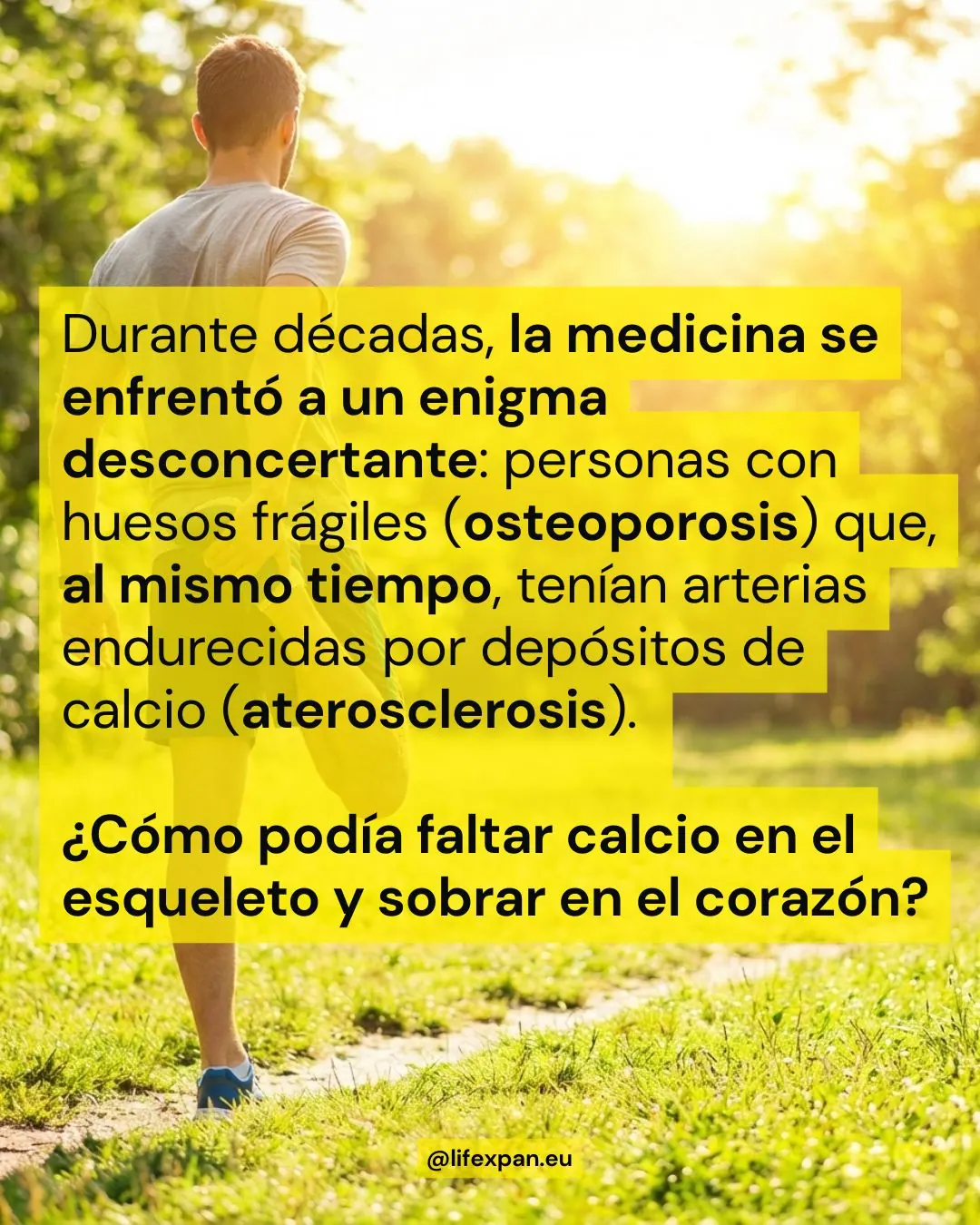
For decades, medicine faced a puzzling enigma: people with fragile bones (osteoporosis) who, at the same time, had arteries hardened by calcium deposits (atherosclerosis). How could calcium be lacking in the skeleton while there was an excess in the heart?
The answer is Vitamin K2 deficiency. When D3 levels are high but K2 levels are low, the absorbed calcium doesn't find its way to the bone and ends up settling in soft tissue instead.
Imagine your arteries as elastic hoses. Poorly managed calcium gradually turns them into rigid ceramic pipes. This phenomenon, known as ectopic calcification, is one of the strongest predictors of cardiovascular risk. Vitamin K2 acts as a molecular cleaner, making sure calcium becomes bone-building material rather than arterial rubble.
The Third Pillar: Magnesium as the "ignition key"
One supporting player is often overlooked, yet it's essential: Magnesium. In this three-way system, magnesium acts as the cofactor that allows enzymes to transform the Vitamin D we take (or synthesise from sunlight) into its active hormonal form (calcitriol).
If you have low magnesium levels, you could take massive amounts of Vitamin D3 and still experience functional resistance. Your body simply can't process it. What's more, high D3 intake depletes magnesium reserves, which explains why some people feel cramps or fatigue when they start supplementing with D3 on its own.
Table: The Calcium Management System
|
Nutrient |
Role in the Body |
Operational Metaphor |
Deficiency Risk |
|
Vitamin D3 |
Intestinal absorption |
The "Doorman" who lets the material in. |
Rickets, weakened immunity. |
|
Magnesium |
Enzymatic activation |
The "Key" that starts the D3 engine. |
Vitamin D resistance, arrhythmias. |
|
Vitamin K2 |
Distribution and fixation |
The "Navigator" who directs calcium to the bone. |
Arterial calcification, fractures. |
MK-4 or MK-7? The importance of persistence
Not all Vitamin K2 forms are equal. There are mainly two forms on the market: MK-4 and MK-7.
Current scientific research, including the 2025 AVADEC study, highlights the superiority of MK-7. While MK-4 disappears from the blood in just a couple of hours, MK-7 has a half-life of around 72 hours. This allows it to travel to every corner of the body, keeping constant watch over your arteries and bones with a single daily dose.
Benefits beyond bone: Longevity and Metabolism
The synergy between D3 and K2 doesn't just protect your structure. Recent studies such as COSMOS (2026) suggest that this balance may slow down biological ageing. By correctly regulating calcium, oxidative stress damage to cells is prevented and insulin sensitivity is improved.
Even in modern conditions such as Long COVID, the combination of optimised doses of D3 (2000 IU) and K2 MK-7 (240 mcg) has been shown to reduce fatigue and systemic inflammation, reinforcing the biological barriers that the virus often compromises.
Conclusion: A precision strategy
Taking Vitamin D3 on its own is a practice from the last century. Cutting-edge science invites us to view the body as a system of interconnected flows. To ensure a resilient bone architecture and a flexible cardiovascular system, the D3 + K2 + Magnesium triad is the gold standard.
Before starting any protocol, it's essential to check the stability of the supplements (K2 is sensitive to light) and, of course, to consult a professional if you're being treated with anticoagulants such as warfarin, since K2 is directly involved in blood clotting mechanisms.
Sources used
Vitamin D and Vitamin K: Synergistic Roles and Emerging Evidence for Combined Supplementation
The Synergy of Vitamin D3 and Vitamin K2 Supplementation
Vitamin D3 + K2: How Are They Connected?
The Critical Combo (Vitamin D and Vitamin K2)
Can Vitamin K2 and D3 Support Blood Vessel Health in Long COVID?
How to combine vitamin D and vitamin K properly
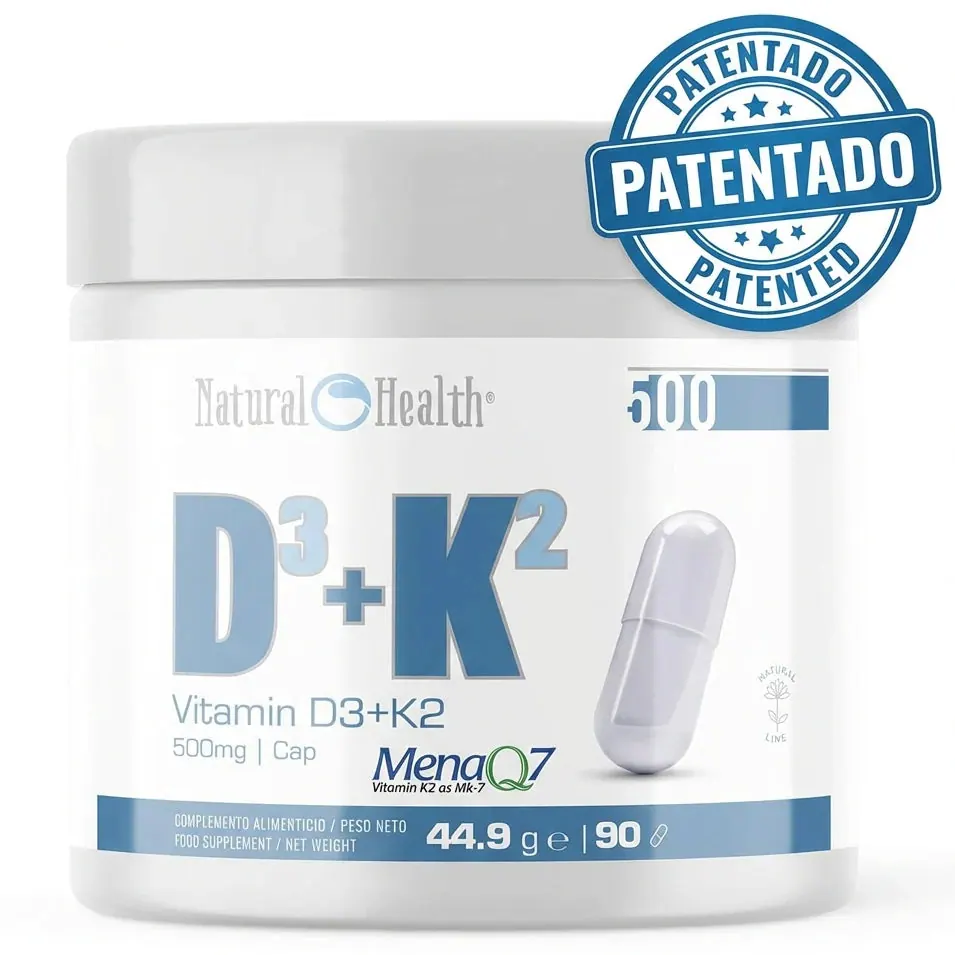
And if you decide to try this supplement, here's our Vitamin D3 + K2 | Patented MenaQ7® with K2 - Mk-7 | High bioavailability and extended-release effect | 90 capsules.
Benefits of vitamin K2 for the arteries Bioavailability Arterial calcification and vitamin K2 Ectopic calcification Bone density Mineral homeostasis Menaquinone-7 (MK-7) Calcium metabolism Carboxylated osteocalcin Matrix Gla protein (MGP) Relationship between magnesium and vitamin D3 Risks of taking vitamin D3 alone Cardiovascular health Nutritional synergy Vitamin D3 and K2 Why take vitamin D3 with K2?