
 MXN
 Spain & Europe · EUR
 United States · USD
Is coenzyme Q10 only for older people? What the science says
There's a widespread idea about coenzyme Q10: that it's "for older people". A supplement you only start to consider from around 60, once your body no longer produces as much as it used to. It's true that production declines with age — but the full story is more interesting, and it completely changes who might actually benefit from it.
Because the synthesis of coenzyme Q10 doesn't start declining at 60. It starts much earlier. And its two main functions — producing energy and neutralising free radicals — aren't needs exclusive to later life: they matter in every cell, at any age. In this article, we explain what Q10 actually does and why the idea that "it's only for older people" falls short.
⚡ Cellular Energy & Longevity · 6 min read · Educational information
What coenzyme Q10 is and what it does in your body
Coenzyme Q10 (CoQ10) is a compound that your own body produces and that's present in practically all of your cells, concentrated mainly in the mitochondria. It performs two fundamental functions, and understanding them is key to seeing why it matters at any age.
First function: producing energy. CoQ10 is an essential part of the electron transport chain, the process by which the mitochondria generate ATP — the energy molecule your body uses for absolutely everything: moving, thinking, breathing, regenerating tissue. Without sufficient CoQ10, that energy production becomes less efficient.
Second function: protecting as an antioxidant. CoQ10 — especially in its reduced form, ubiquinol — acts as a fat-soluble antioxidant, capable of neutralising free radicals and protecting cell membranes, lipids, proteins and DNA from oxidative damage.
Practically all the benefits attributed to coenzyme Q10 stem from these two abilities: generating energy and slowing oxidative damage. Everything else follows from these two basic functions.
💡 In simple terms
Think of CoQ10 as doing two jobs at once inside every cell: it's part of the engine that generates energy, and at the same time it's part of the system that clears away the "smoke" that engine produces. Energy and protection, in the same molecule. And neither of those needs disappears just because you're young.
The fact that overturns the "it's only for older people" idea
Here's the point that debunks the myth. The body's natural production of coenzyme Q10 peaks at around 20-25 years old and begins to decline from that age onwards. Not at 60. From the age of 30, many people already have lower levels than in their youth, and that decline continues gradually over the years. Levels in the brain, for example, drop markedly from age 50 onwards.
In other words: by the time you reach "the age when you're supposed to start taking Q10", you've already spent two or three decades producing less of it. The drop isn't a sudden event of old age, but a slow process that begins in youth.
Why a young adult could benefit
If production is already declining and Q10's functions matter at every stage of life, why is it associated only with old age? Largely, it's down to habit and marketing. But there are specific reasons why a younger person might have an interest in it:
Lifestyle accelerates oxidative damage. Chronic stress, smoking, alcohol, pollution, very intense exercise and a poor diet all increase the production of free radicals. Because of their pace of life, many young people build up more oxidative damage than their body can comfortably neutralise. This is where an antioxidant like CoQ10 has a role to play.
Demanding sport increases the demand. Intense physical activity drives up both the need for energy and the generation of free radicals. Athletes — of any age — are a clear example of a younger population with a high demand for both of Q10's functions.
Starting earlier can make a real difference in the long run. There's a preventive logic here: maintaining good CoQ10 status and protecting cells from accumulated damage well before decline becomes significant is a strategy that fits with how cellular ageing actually works — a gradual, cumulative process.
🔬 Key fact
Cellular ageing isn't a switch that flips at a certain age, but the progressive build-up of damage over the years. That's why strategies that protect the cell make more sense the earlier they're adopted: it's not about reversing damage that's already set in, but about reducing how much accumulates from the outset.
The two forms of Q10: ubiquinone and ubiquinol
If you're considering coenzyme Q10, it's worth knowing it exists in two forms. Ubiquinone is the oxidised form — the most common and affordable — which the body converts into the active form. Ubiquinol is the reduced, active form, ready to use, with superior bioavailability.
Which should you choose? It depends. In young, healthy people, the body converts ubiquinone into ubiquinol efficiently, so both forms work well. From a certain age onwards, or in people with reduced conversion capacity, direct ubiquinol may be more efficient. But beyond the form itself, there's a factor that research points to as decisive: absorption.
The real bottleneck: absorption
Coenzyme Q10 has a well-known problem: it's fat-soluble and difficult to absorb. It needs fat to be assimilated, has to be taken with meals, and even then a good deal of it is lost along the way. This is why many CoQ10 supplements deliver a lot less than their label promises — the issue isn't the dose, it's how much actually reaches the cells.
That's why the most relevant innovation in this field hasn't been raising the dose, but solving the absorption problem. And that's where our new product's approach comes in.
CavaQ10® + TetraSOD®: Q10 designed to be absorbed
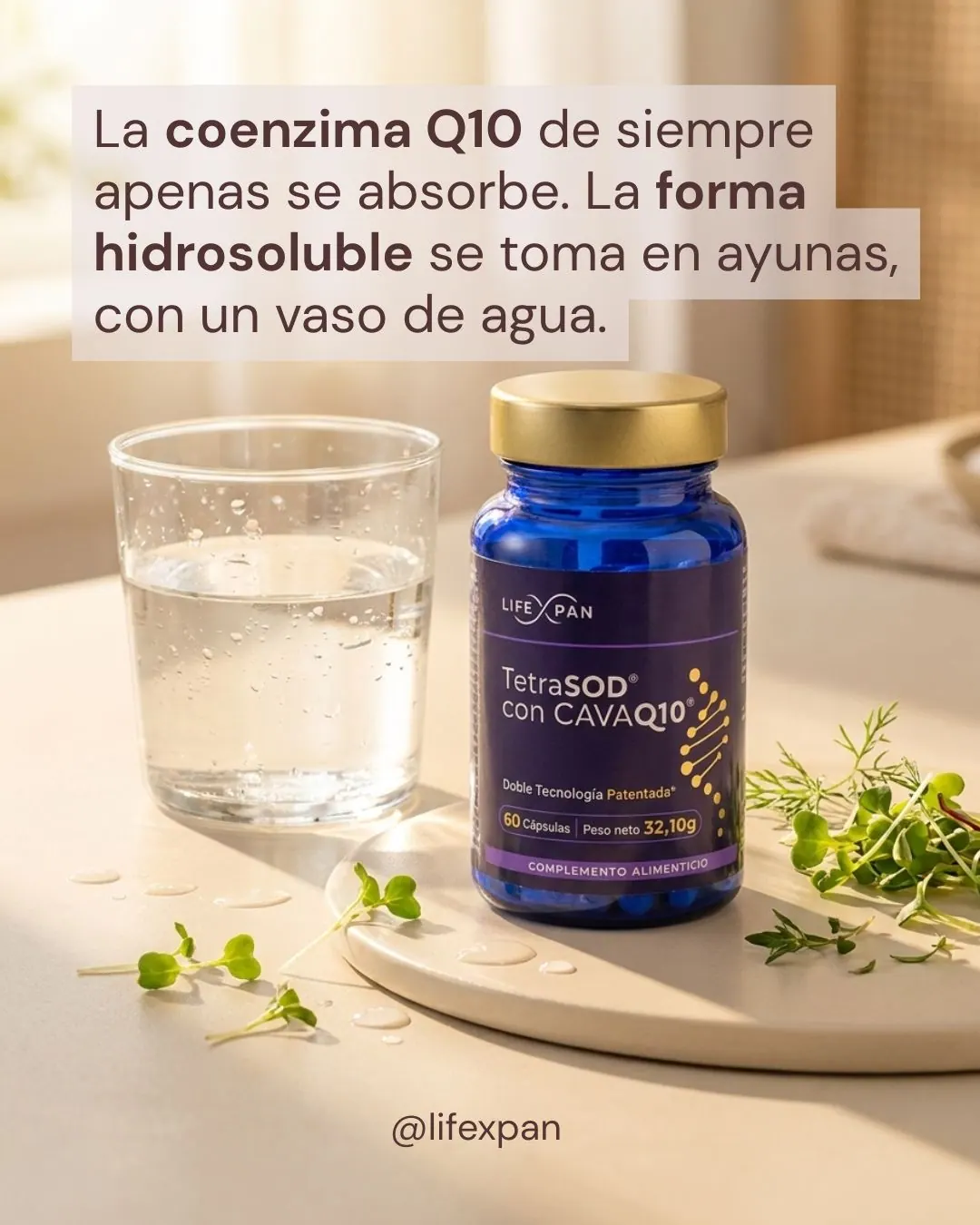
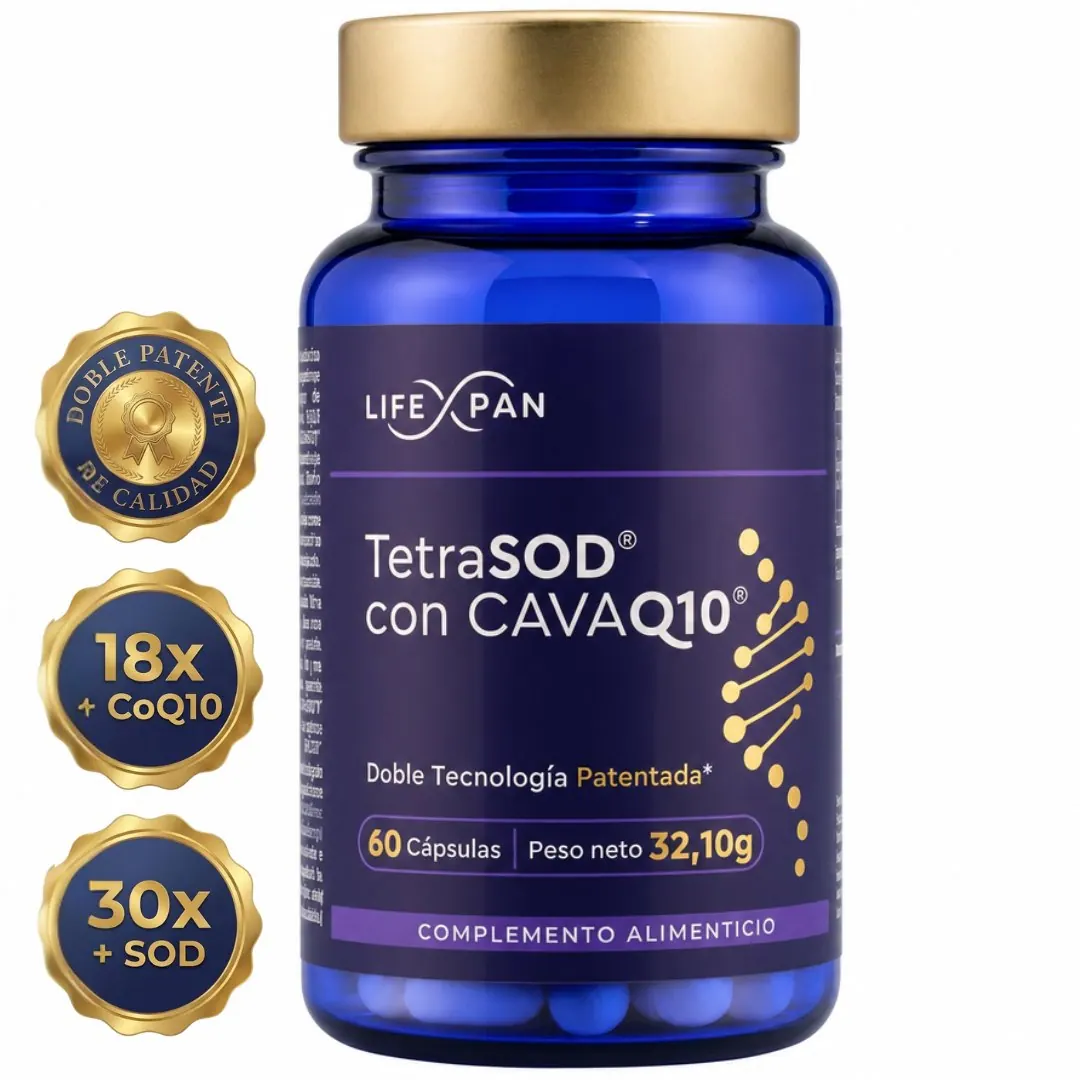
At LifeXpan we've incorporated coenzyme Q10 in a form that solves precisely this bottleneck. CavaQ10® is the first water-soluble CoQ10: thanks to gamma-cyclodextrin technology, it dissolves in water and doesn't depend on dietary fat to be absorbed. This allows it to reach up to around 18 times the bioavailability of conventional CoQ10, and it can comfortably be taken on an empty stomach, with just a glass of water.
To this high-absorption CoQ10 we've added TetraSOD®, an extract from a marine microalga that provides superoxide dismutase — one of the body's own frontline antioxidant enzymes. The combination strengthens the two functions we've discussed: supporting energy production and reinforcing the cell's antioxidant defences.
And it fits naturally alongside the rest of an energy protocol: taken in the morning, together with Pure NR. While NR helps replenish NAD⁺ — the fuel — CoQ10 supports converting that potential into usable energy — the spark.
⚠️ An important note
Coenzyme Q10 is not a medicine and does not treat any disease, and it isn't the solution for everyone or for everything. If you take anticoagulants, blood pressure medication, or other drugs, or if you're pregnant or breastfeeding, consult your healthcare professional before supplementing. Food supplements do not replace a varied, balanced diet or a healthy lifestyle.
Conclusion: Q10 doesn't care about age
The idea that coenzyme Q10 is "only for older people" comes from a half-truth. Yes, its production falls with age — but it starts declining while you're still young, and its two essential functions, generating energy and protecting against free radicals, matter in every cell throughout life.
This doesn't mean everyone should take it, or that it's a miracle solution — it isn't. It means something more nuanced and more useful: if you're interested in looking after your cellular energy and oxidative balance, the relevant question isn't so much "am I old enough yet?" as "do my lifestyle and goals justify it?". And that's a conversation worth having at 35, at 50 and at 70.
⚡ LifeXpan® CavaQ10® + TetraSOD®
Scientific references
Hernández-Camacho, J.D. et al. (2018). Coenzyme Q10 Supplementation in Aging and Disease. Frontiers in Physiology, 9, 44.
Pravst, I. et al. (2020). Comparative Bioavailability of Different Coenzyme Q10 Formulations in Healthy Elderly Individuals. Nutrients, 12(3), 784.
Bhagavan, H.N. & Chopra, R.K. (2006). Coenzyme Q10: Absorption, tissue uptake, metabolism and pharmacokinetics. Free Radical Research, 40(5), 445–453.
Littarru, G.P. & Tiano, L. (2007). Bioenergetic and antioxidant properties of coenzyme Q10. Molecular Biotechnology, 37(1), 31–37.
Saini, R. (2011). Coenzyme Q10: The essential nutrient. Journal of Pharmacy and Bioallied Sciences, 3(3), 466–467.
at what age does coenzyme Q10 start to decline cellular anti-ageing benefits of Q10 at any age endogenous biosynthesis stem cells coenzyme Q10 young people what is coenzyme Q10 for CoQ10 benefits by age when to start taking CoQ10 difference between ubiquinol and ubiquinone cellular ageing reversible cellular ageing is coenzyme Q10 only for older people what is coenzyme Q10 for in young people mitochondrial ATP production Q10 energy and antioxidant free radicals oxidative stress Cardiovascular health ubiquinol vs ubiquinone