
 MXN
 Spain & Europe · EUR
 United States · USD
What is NR (nicotinamide riboside): a guide from scratch
You've seen the letters NR on social media, on a label, or in a conversation about longevity, and you're not quite sure what it actually is. That's completely normal: it gets talked about a lot but explained very little. In this guide, we start from scratch: what it is, what your body does with it, what European regulation says, and how to take it. No miracle promises.
🧬 Guide from scratch · 5 min read · Informational content
What is NR?
NR stands for nicotinamide riboside. It's a molecule related to vitamin B3: the European Food Safety Authority (EFSA) concluded that it is a source from which nicotinamide, a form of niacin, can be absorbed. In other words, it belongs to the vitamin B3 family, but it isn't "the usual vitamin B3".
What makes it interesting is what your body does with it: it uses it as a raw material to make NAD⁺.
NR and NAD⁺: what's the difference?
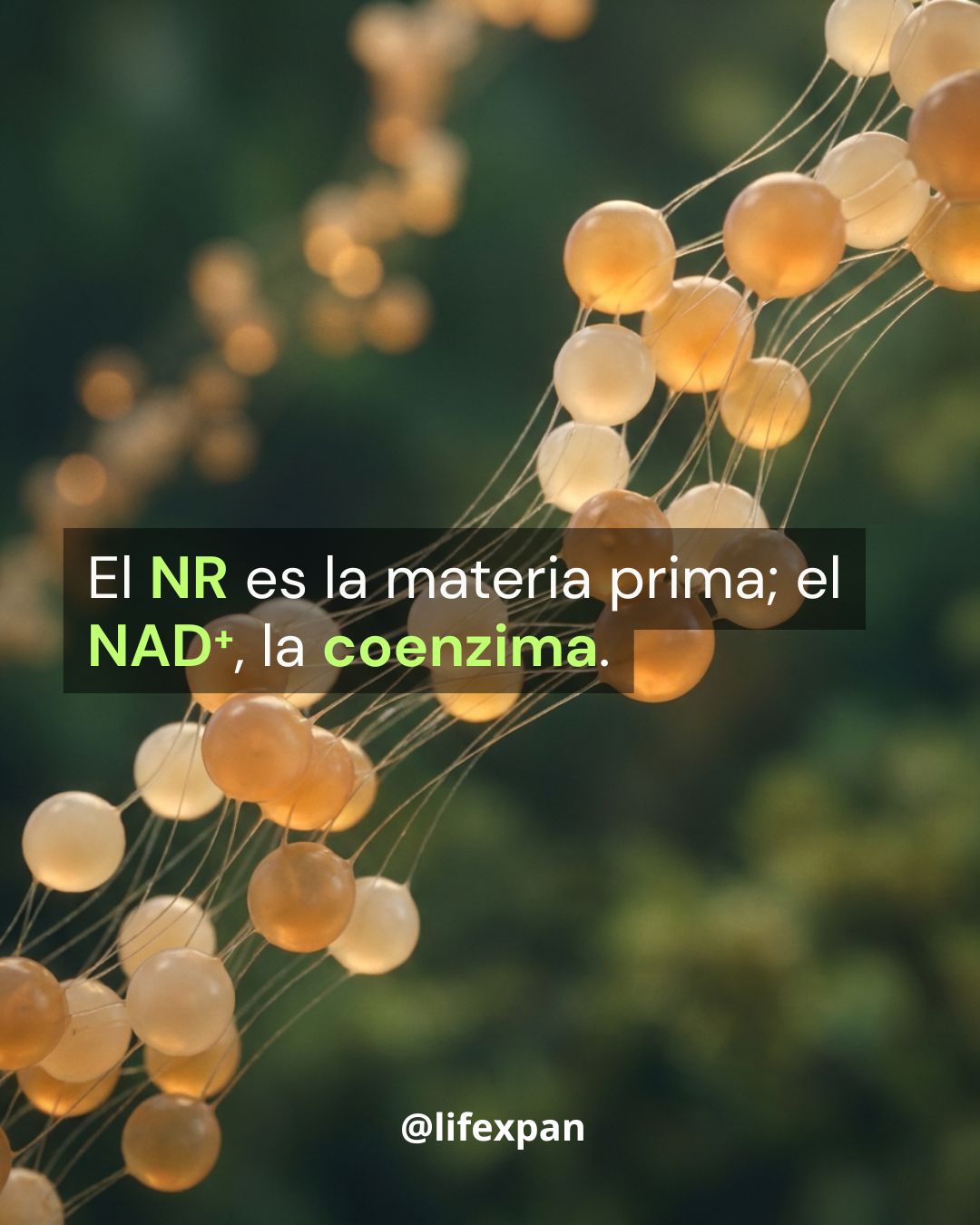
NAD⁺ (nicotinamide adenine dinucleotide) is a coenzyme present in every one of your cells. It plays a part in how your body obtains energy from food, among other cellular processes. NR is not NAD⁺ itself: it's a precursor, meaning a building block that the body can convert into NAD⁺.
A 2016 study published in Nature Communications described the oral bioavailability of NR in mice and in people and found that it could raise NAD⁺ levels in humans. A later 2018 trial in middle-aged and older adults found that taking NR consistently was well tolerated and raised NAD⁺.
💡 In simple terms
NAD⁺ is the coenzyme. NR is one of the building blocks your body can use to make it. Taking NR isn't the same as "taking NAD⁺": it's giving your body a raw material.
Why does NR come up when people talk about ageing?
Because NAD⁺ levels aren't fixed throughout life. A paper published in PLoS ONE studied age-related changes in oxidative stress and NAD⁺ metabolism in human tissue, and it's one of the references that has fuelled interest in NAD⁺ precursors. That's why NR comes up in conversations about ageing and cellular energy.
Let's be clear: scientific interest doesn't mean a supplement can treat any disease or "stop" ageing. NR is a food supplement, and that's how it should be regarded.
Is it safe? What European regulation says
In the European Union, nicotinamide riboside chloride is authorised as a novel food in food supplements, following an assessment by EFSA. That assessment concluded it is safe for the healthy adult population, at up to 300 mg per day (with a different consideration for pregnancy and breastfeeding). According to EFSA, this dose provides a nicotinamide amount six times lower than the tolerable upper intake level for adults.
This authorisation is set out in Commission Implementing Regulation (EU) 2020/16 and was updated in 2022 by Regulation (EU) 2022/1160.
🔬 Key fact
An ingredient being authorised means it has passed a specific safety assessment, under specific conditions of use. It isn't a claim that it "works" for anything in particular.
How do you take it?
LifeXpan® NR PURO is taken as one capsule in the morning, on an empty stomach, with a glass of water. It's a simple habit, easy to build into your routine. If you already take other supplements, you can combine it with them: in our other articles we talk about how it complements coenzyme Q10.
The questions we get asked most
Are the brand and the product the same thing? No. LifeXpan® is the brand; NR PURO is one of its products.
Is NR the same as vitamin B3? It belongs to the same family, but it isn't the same thing. NR is a precursor of NAD⁺ and was assessed as its own ingredient.
Is there a daily limit? Yes: the European authorisation sets a limit of 300 mg a day for healthy adults.

⚠️ An important note
If you take regular medication, are pregnant or breastfeeding, speak to your healthcare professional before supplementing. Food supplements are not a substitute for a varied and balanced diet and a healthy lifestyle.
Conclusion
NR is a precursor of NAD⁺, a coenzyme your body uses every day and whose levels change with age. It's authorised in the EU as a food supplement, with a safety limit assessed by EFSA, and it's taken in a very simple way. Understanding what it is—and what it isn't—lets you decide with good judgement, without the noise.
🧬 NR PURO by LifeXpan®
Nicotinamide riboside for your morning routine. One capsule a day.
Scientific references
EFSA NDA Panel (2019). Safety of nicotinamide riboside chloride as a novel food pursuant to Regulation (EU) 2015/2283 and bioavailability of nicotinamide from this source. EFSA Journal, 17(8):5775.
European Commission (2020). Commission Implementing Regulation (EU) 2020/16 authorising the placing on the market of nicotinamide riboside chloride as a novel food. Amended by Implementing Regulation (EU) 2022/1160.
Trammell, S.A.J. et al. (2016). Nicotinamide riboside is uniquely and orally bioavailable in mice and humans. Nature Communications, 7, 12948.
Martens, C.R. et al. (2018). Chronic nicotinamide riboside supplementation is well-tolerated and elevates NAD+ in healthy middle-aged and older adults. Nature Communications, 9, 1286.
Massudi, H. et al. (2012). Age-associated changes in oxidative stress and NAD+ metabolism in human tissue. PLoS ONE, 7(7), e42357.
Informational content. This does not constitute an authorised health claim.
coenzima how to take nicotinamide riboside food supplement how many mg of NR per day difference between NR and vitamin B3 EFSA cellular energy mitocondrias NAD⁺ NAD+ and ageing niacina nicotinamide riboside novel food is NR safe NR supplement NAD+ precursor what is nicotinamide riboside and what is it for what is NR vitamin B3