
 MXN
 Spain & Europe · EUR
 United States · USD
What your grandmother couldn't have known about longevity
There's an idea we take for granted without realising how recent it actually is: that ageing isn't simply "the passage of time", but a process with concrete mechanisms — cellular damage, division limits, the wearing down of specific structures — which, up to a point, can be influenced. It sounds like common sense. But it isn't, and it hasn't been for almost all of human history.
Your grandmother, or your great-grandmother, lived much of her life in a world where science didn't even have the vocabulary to explain why we age. Much of what's covered today in a popular science article is less than 70 years old — and some of the most important discoveries are less than 20. This is a brief journey through that surprisingly short history.
🕰️ History of Science & Longevity · 7 min read · Educational information
1956 — For the first time, an explanation of why we age
For centuries, ageing was explained as a given — "the passage of time", with no mechanism behind it. That changed in 1956, when scientist Denham Harman proposed the free radical theory of ageing: the idea that unstable molecules — generated, among other processes, by cellular respiration itself — progressively damage the body's structures throughout life.
It was the first time in history that a concrete mechanism was proposed for ageing, not just a description that it happens. Before 1956, the concept of a "free radical" wasn't even part of the vocabulary around ageing.
💡 In simple terms
Until the mid-20th century, science described ageing almost the way it would describe the weather: something that just happens, without asking too much about the mechanism behind it. 1956 is the moment it began to be treated as a biological process with an identifiable cause — the starting point for everything that followed.
1961 — Cells aren't immortal, and that changed everything
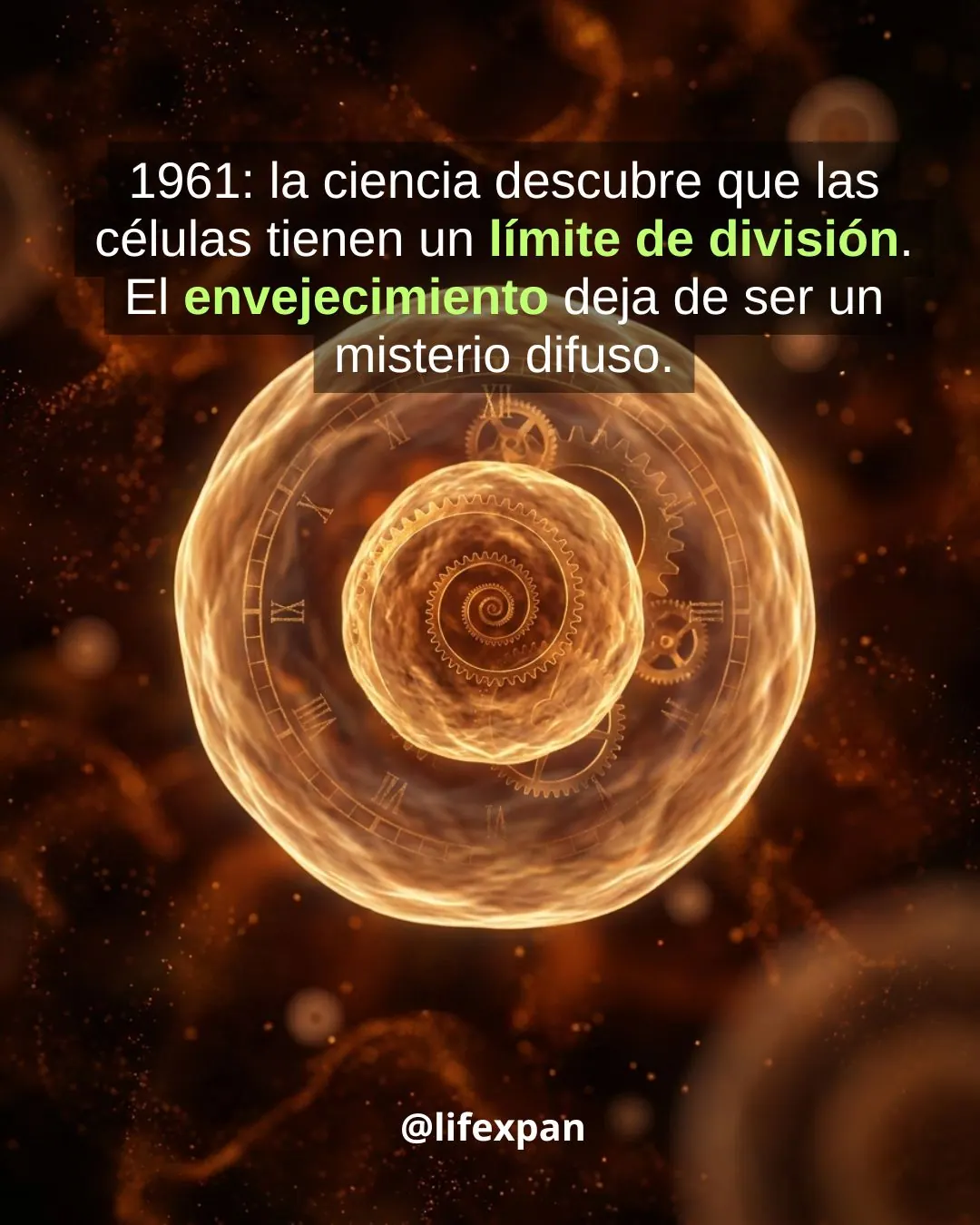
For decades it was assumed that cells, grown in a lab, could divide indefinitely. In 1961, biologist Leonard Hayflick showed this wasn't the case: human cells have a limited number of divisions — between 50 and 60 — before they stop replicating. This limit is known today as the "Hayflick limit".
It was an enormous conceptual shift: if cells have a biological division limit, ageing stops being a vague mystery and starts having an explanation at a cellular level that can be measured and studied.
2009 — A Nobel Prize for understanding why that limit exists
Almost two decades would pass before we began to understand why the Hayflick limit exists. The key piece is telomeres — the protective ends of our chromosomes — which shorten a little each time a cell divides. When they become too short, the cell stops replicating.
The work that established this connection took years and the contribution of several researchers, until in 2009 Elizabeth Blackburn, Carol Greider and Jack Szostak received the Nobel Prize for describing how telomeres and the enzyme telomerase protect chromosomes. It's worth pausing on the date: this isn't a mid-20th-century discovery. It's a Nobel Prize awarded less than a generation ago.
🔬 Key fact
If you're between 30 and 50 years old, there's a good chance you'd already been born when science hadn't yet fully established the role of telomeres in cellular ageing. That's how recent it is.
The 1990s and 2000s — The pathways we know today emerge
In the following decades, research identified a set of mechanisms that today are at the heart of longevity science: sirtuins — a family of NAD⁺-dependent regulatory proteins — and nutrient-sensing pathways such as mTOR and AMPK, which turned out to be central regulators of how the body ages and responds to diet, fasting and exercise.
It is precisely this body of knowledge — relatively young, in historical terms — that today explains why there's so much talk of NAD⁺, calorie restriction, intermittent fasting: these aren't trends without foundation, they're concepts that are only just beginning to have a solid mechanistic explanation.
✨ The key idea
Almost everything that's explained today about longevity with apparent ease — free radicals, telomeres, NAD⁺, sirtuins — is knowledge that has been built up in little more than half a century, much of it in the last two or three decades. Our grandmothers had access to none of these explanations.
What this means today
This isn't an anecdotal fact. It means we're living in the first moment in history when, on genuine scientific grounds, ageing can be thought of as a process with levers we can act on — not simply accepted as something that just happens. It also means this field is still moving fast: what's known for certain today will likely be expanded in the coming decades, just as happened between 1956 and 2009.
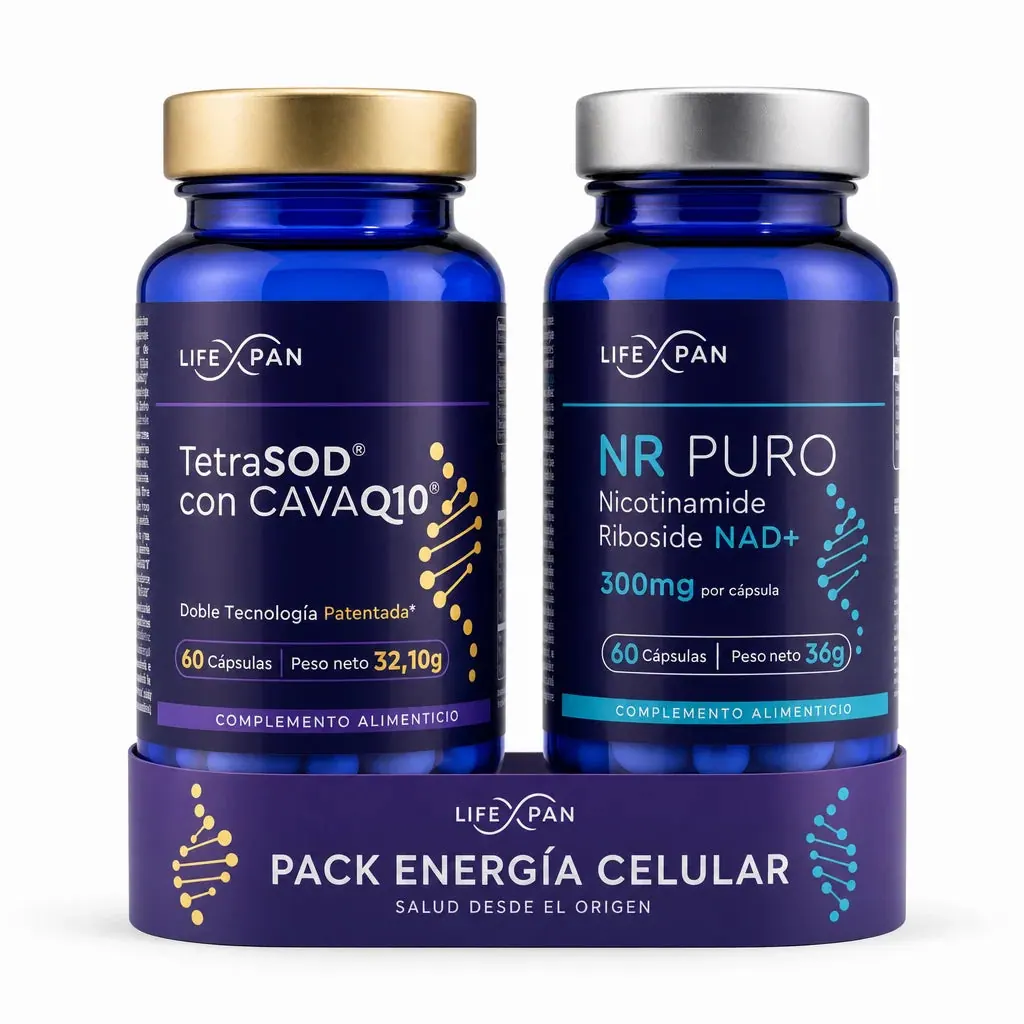
Products like NR or coenzyme Q10 don't exist in a vacuum — they're the practical translation of this recent body of knowledge about NAD⁺ and mitochondrial function, applied to something as everyday as a daily routine.
⚠️ An important note
The fact that science has advanced a great deal doesn't mean everything is settled. Many of these pathways remain the subject of active research, and translating these mechanisms into concrete interventions in humans is progressing carefully and with gradual evidence, not absolute certainties.
Conclusion
Next time you read something about mitochondria, NAD⁺ or free radicals and it feels like "common knowledge", it's worth remembering that it isn't. It's new knowledge, built up over the span of a couple of generations — ours is, quite literally, the first moment in history when ageing can be understood in this level of detail.
🕰️ The science behind LifeXpan®
Pure NR and CavaQ10® + TetraSOD®: the practical application of decades of recent research into NAD⁺, mitochondria and cellular antioxidant defence.
Scientific references
Harman, D. (1956). Aging: a theory based on free radical and radiation chemistry. Journal of Gerontology, 11(3), 298–300.
Hayflick, L. & Moorhead, P.S. (1961). The serial cultivation of human diploid cell strains. Experimental Cell Research, 25(3), 585–621.
Amano, H. & Sahin, E. (2019). Telomeres and sirtuins: at the end we meet again. Molecular & Cellular Oncology. (Cell, 2020 review).
The Nobel Assembly at Karolinska Institutet (2009). The Nobel Prize in Physiology or Medicine 2009 — Press release.
Longo, V.D. et al. (2015). Interventions to Slow Aging in Humans: Are We Ready? Aging Cell, 14(4), 497–510.
Informational content. This does not constitute an authorised health claim. Food supplements should not be used as a substitute for a varied and balanced diet.
recent science of ageing when telomeres were discovered history of longevity science Hayflick limit 2009 Nobel Prize for telomeres free radical theory of ageing